The DanceSport Music Guide · Dancers Edition

Bring a smile to your feet through music.

Feel the pulse. Follow the melody. Notice the moment the energy changes.

The Dancers Edition introduces Sylvain van Hemert’s DanceSport Music Guide from the dancer’s point of view. It offers a simple way to understand what you hear, recognise the character of a dance and explore how the music develops.

Dancers Edition · Version 1.3

A look inside the Dancers Edition
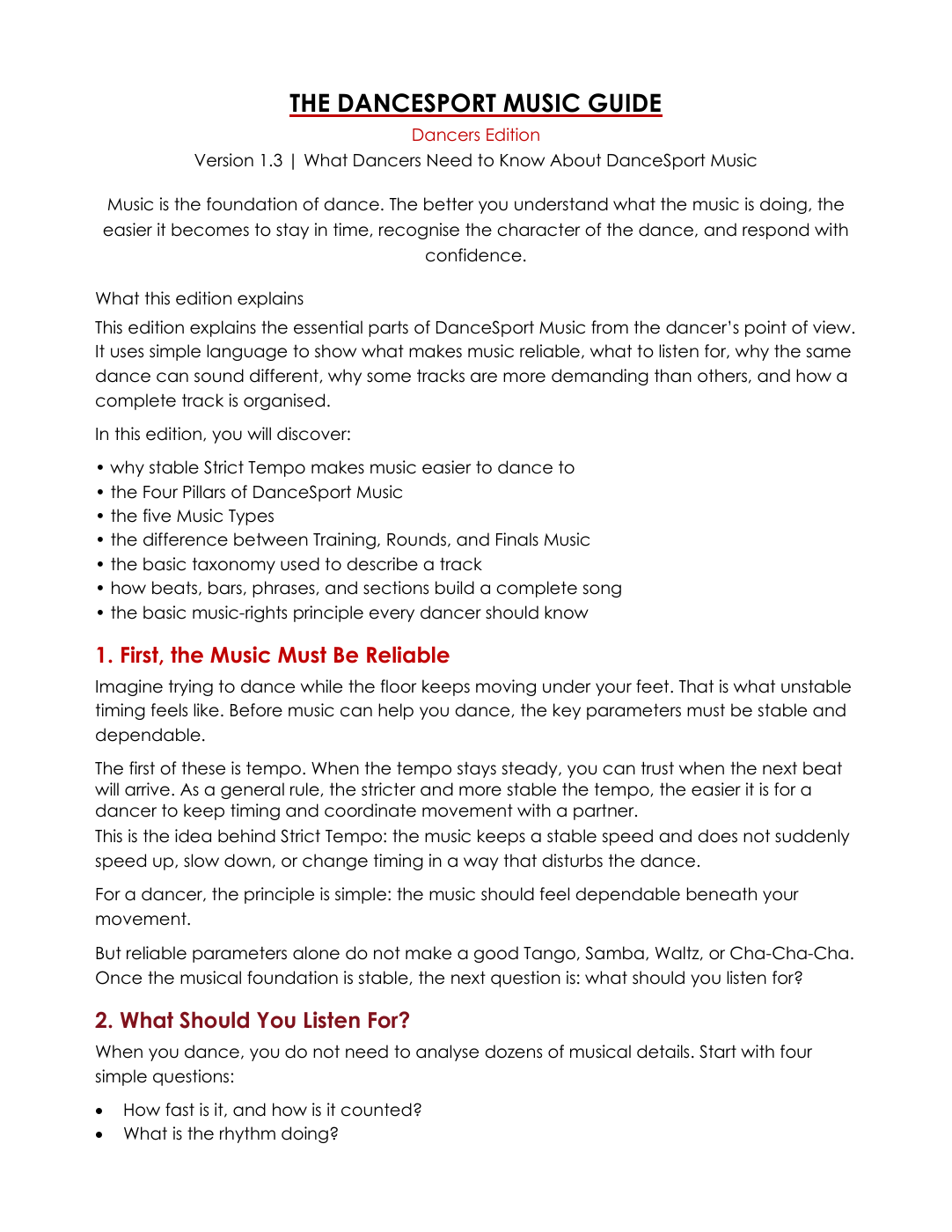
Opening page of the Dancers Edition
Opening page · Dancers Edition
Page detail from the DanceSport Music Guide
A detail from the Guide

Start with a rhythm you can trust

The edition begins with Strict Tempo: a stable musical speed that gives a dancer a dependable foundation. Once that foundation is clear, the next step is to listen to the character and development of the music.

Four pillars. Four ways to listen.

The Guide organises the musical foundation into four pillars. Each one gives you a different question to bring to your next track.

01 · Parameters

How fast is the music, and how is it counted? Explore tempo, meter, phrasing and structure.

02 · Rhythm

What gives the music its rhythmic character? Listen for pulse, groove and accents.

03 · Melody

Where is the musical line going? Follow its direction and expression.

04 · Dynamics & Energy

How does the intensity change? Notice contrast, development and the kind of movement the music invites.

One dance. Different sounds.

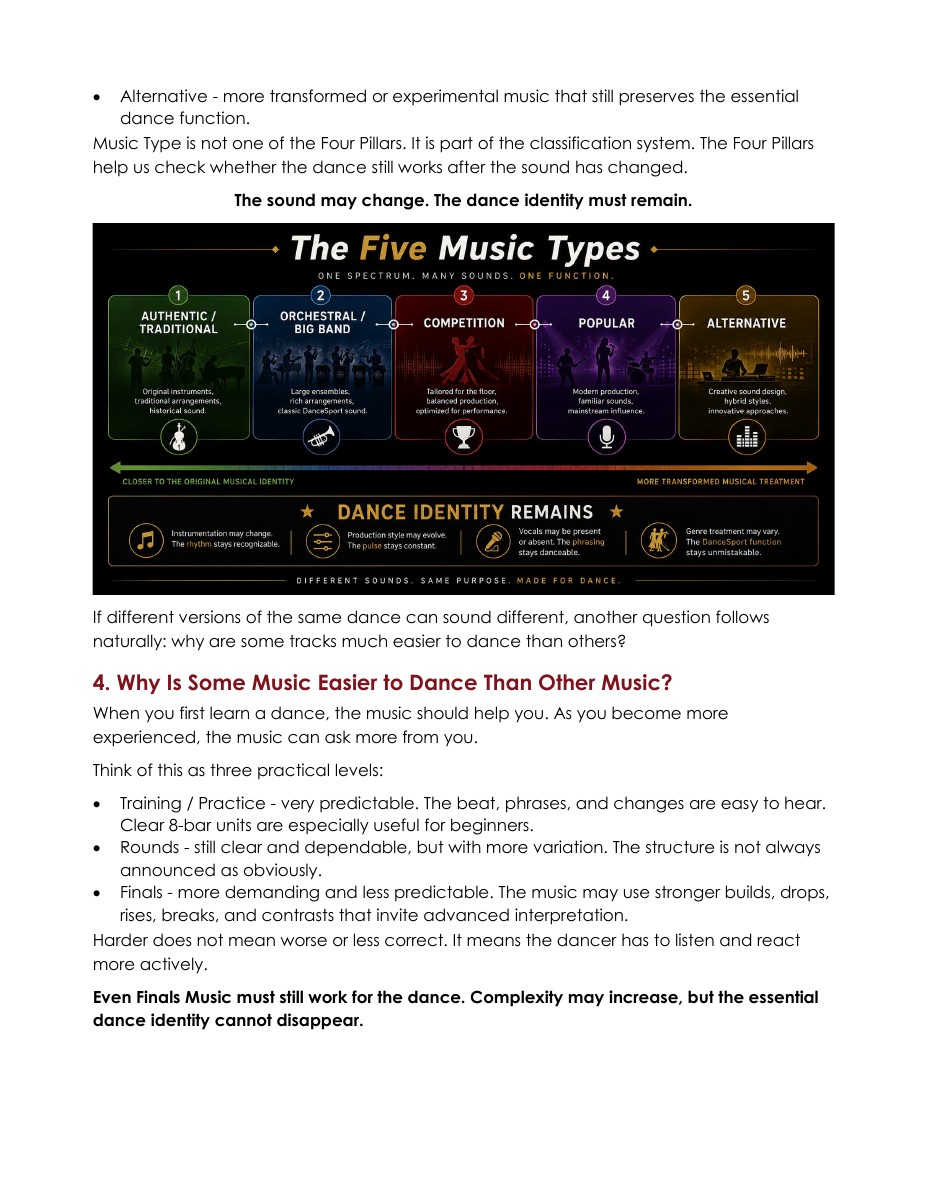
Two Cha-Cha-Cha recordings can sound very different. The edition describes five Music Types: different approaches to the sound, with the essential dance function preserved. Music Type belongs to the classification system; it is separate from the Four Pillars.

  • Authentic / Traditional: rooted in the original musical identity of the dance.
  • Orchestral / Big Band: a ballroom or ensemble approach.
  • Competition: shaped for DanceSport clarity and function.
  • Popular: familiar or contemporary music that works for the dance.
  • Alternative: transformed or experimental approaches that retain the dance function.

Choose the challenge that fits the moment

The edition distinguishes three practical levels. More demanding music calls for more active listening and interpretation, while retaining the essential identity of the dance.

Training / Practice

Predictable timing and clearly audible phrases and changes. Clear 8-bar units can help beginners find their place.

Rounds

A dependable foundation with more musical variation and less obvious structural signposting.

Finals

More contrast, builds, breaks and changes in energy, inviting more advanced interpretation.

Hear the whole track

Beats form bars, bars form phrases, and phrases build larger sections. Together, those sections make the complete track. The edition uses this progression to explain how a dancer can listen beyond individual beats.

Beats → Bars → Phrases → Sections → Complete track

Many DanceSport tracks use clear 8-bar phrases. The Guide introduces this as a useful listening pattern, rather than a rule that every piece of music must follow.

Try it with your next track

Choose a track you enjoy and listen once without dancing. Ask yourself:

  1. Which dance does it suggest?
  2. Which Music Type best describes its sound?
  3. Who would it suit?
  4. How much interpretation does it ask from the dancer?
  5. Where would you use it: practice, competition, a show or a social dance?

These questions adapt the edition’s simple classification approach into a short listening exercise.

What this edition covers

This seven-page introduction brings together Strict Tempo, the Four Pillars, the five Music Types, Training / Rounds / Finals, basic classification and song structure. It also introduces a practical point about music rights.

The Dancers Edition is an accessible entry into the wider Guide framework. It gives dancers a starting vocabulary without requiring them to learn the full professional classification system.

Explore the music behind your movement

Sylvain van Hemert is the author of The DanceSport Music Guide, a music producer and DanceSport music specialist. Interested in the Dancers Edition or its application to teaching, DJ work or repertoire selection?
Contact Dancelife Music

Sylvain van Hemert

Music · Dance · Music Rights · Technology · Business

Connecting music, dance, music rights and technology — and turning ideas into workable business models.

I work as an entrepreneur, initiator and strategic developer, bringing people, repertoire, rights and technology together. My focus is on translating concepts into commercially and operationally workable approaches.

What I bring to a project

A music concept involves more than the recording itself. It also involves the people who create it, the rights that govern its use, the technology that supports delivery and the business arrangements that make it workable.

My role is often to connect these perspectives: working between producers, rights holders, developers, dance organisations, distributors and commercial partners. I help develop the concept, identify the questions that need resolving and bring the relevant parties into the conversation.

Where I can contribute

Repertoire, rights & commercial use

How could a catalogue or music concept fit a licensing or distribution model? I work with master rights, publishing rights, licensing, repertoire ownership and commercial arrangements.

From idea to workable model

How do the musical purpose, commercial proposition and operational requirements fit together? I develop concepts and explore how they can become practical products, services or partnerships.

Connecting partners & systems

How do rights holders, producers, developers and distribution partners work towards the same objective? I connect commercial questions with metadata, royalty models and usage reporting.

Core expertise

Music Rights & Licensing, Strategic Development and Music & DanceSport Expertise form the central combination in my work.

Music Rights & Licensing

Working with master and publishing rights, licensing, repertoire ownership, distribution and royalty models. The Music Rights section develops these topics in more detail.

Strategic Development

Connecting a concept with its intended audience, business arrangements, development priorities and practical delivery.

Music & DanceSport Expertise

Practical experience with dance music, production, repertoire and DJ work, alongside the analytical framework of The DanceSport Music Guide.

Rights, Technology & Data

Connecting rights requirements with metadata, usage reporting and the systems needed to support a music model.

Concept & Product Development

Developing ideas and translating them into product concepts, commercial approaches and operational requirements.

International Partnerships

Working across producers, rights holders, developers, dance organisations, distributors and other commercial partners.

Entrepreneurship

Considering both the opportunity and the work required to organise, develop and operate a business model.

Ideas in practice

Dancelife Music

The commercial music positioning within the DANCELIFE brand, connecting dance music, repertoire and the development of music activities.

Dancelife Music I.P. B.V.

I am CEO and statutory director. My responsibilities include strategy, music rights, intellectual property, catalogue development and international partnerships.

D-Sylz B.V.

I am a director and shareholder. The company handles operational and commercial activities, including production, contracts, licensing and distribution.

The DanceSport Music Guide

I am the author of this systematic method for analysing, classifying and practically assessing music for dance and DanceSport. Explore the Guide

Music4.dance · In development

I am the initiator of this project exploring new approaches to music distribution, licensing, Independent Music, usage logging and reporting for the dance sector. It has not yet been fully commercially launched.

DJ Sylz

My professional DJ and artist name. It represents the practical music and dance experience that informs my wider work with repertoire, production and music concepts.

Professional background

My professional career began in 1992 in the Van Hemert family business, Lederinkooppunt B.V., which later continued as Jos van Hemert Shoes & Music B.V. Starting in a commercial role, I gradually took on broader responsibilities across the activities associated with Dancelife.

Those responsibilities developed across international sales, music production, repertoire, music rights, distribution, partnerships and strategic development. DANCELIFE is a brand whose activities have operated through different business structures over time.

What are you working on?

A repertoire question, a licensing model, a music product or a potential partnership? Tell me what you want to develop, who it is for and which questions you are trying to resolve.

That gives us a useful starting point to discuss the concept, the parties involved and a possible next step.

Discuss a project

Music Rights

Rights · Repertoire · Licensing · Distribution · Data

Connecting music rights with practical commercial and operational models.

Music Rights is a core area of Sylvain van Hemert’s work. This section brings together the questions around repertoire, ownership, licensing, distribution, royalty models and the data needed to support them.

Start with the project

What music is involved? What do you want to do with it? Which rights holders, partners and systems need to be part of the process? These are useful starting points for a conversation about a music concept and its commercial or operational model.

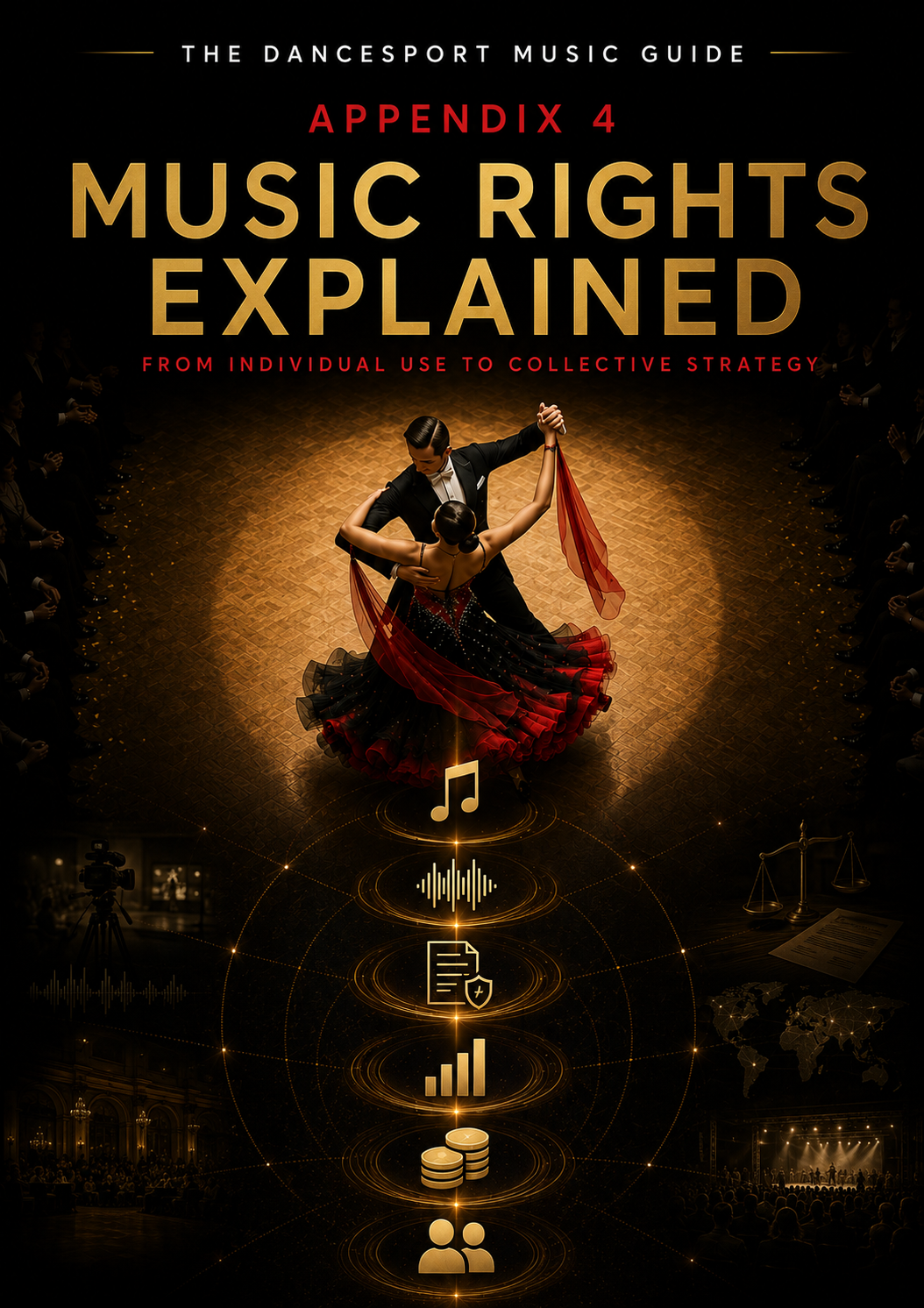
Music Rights Explained — cover
Appendix 4 · Music Rights Explained

THE DANCESPORT MUSIC GUIDE

Music Rights Explained

From a track on a dance floor to a competition livestream: the way music is used changes the questions that need to be answered.

Drawing on Appendix 4 of The DanceSport Music Guide, this introduction connects ownership, permissions, responsibility and reporting with the everyday realities of DanceSport.

Start with four questions: who controls the music, what will happen to it, who needs to arrange permission, and what information should follow the use?

One piece of music. Two foundations.

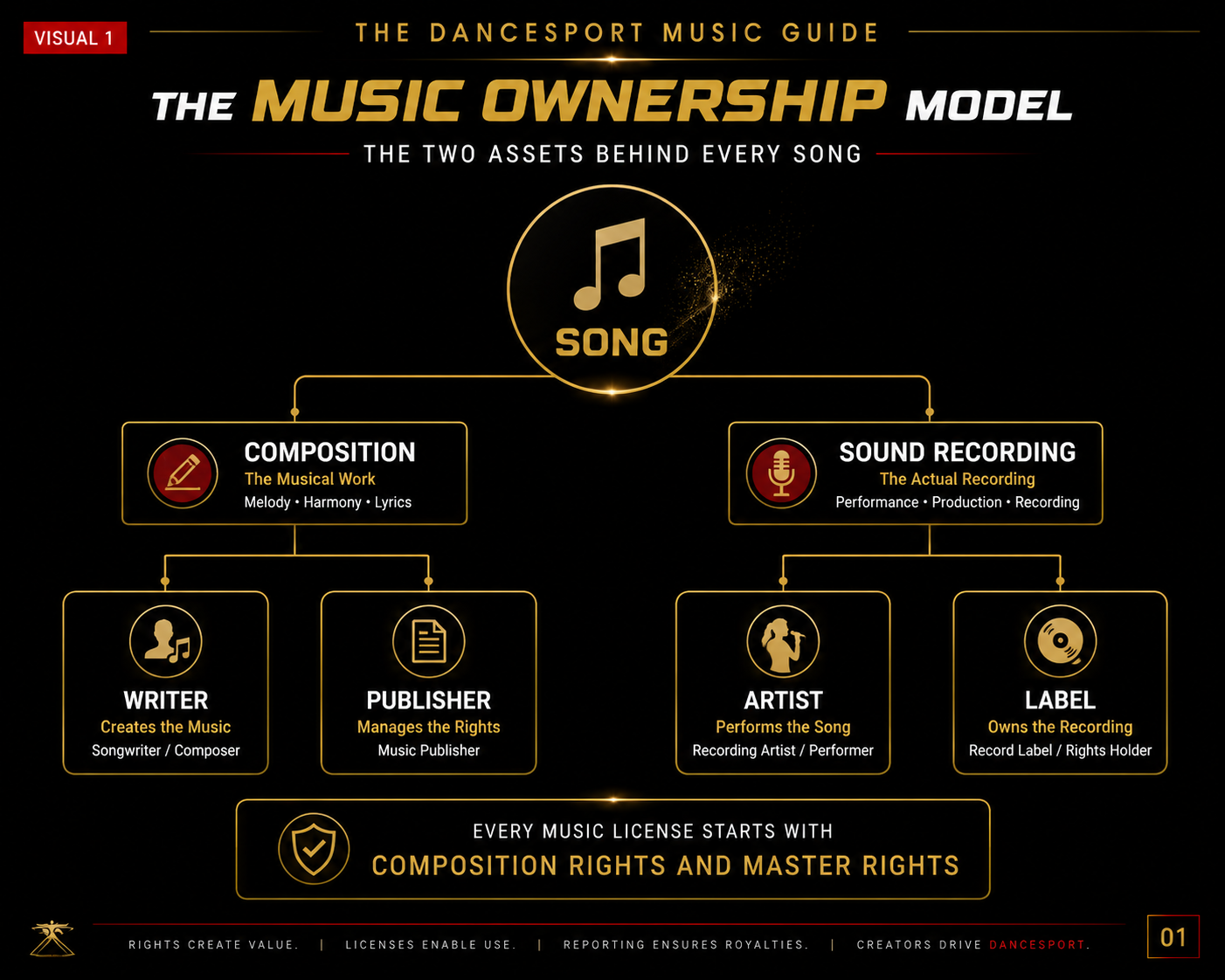
Music ownership model: a song has composition rights and recording rights, involving writers, publishers, artists and labels.
The Music Ownership Model · The DanceSport Music Guide. An overview of the composition and the sound recording. The parties and their rights depend on the recording and agreements. View the full-size visual ↗

The composition

The underlying music and lyrics are associated with songwriters, composers and their publishers. Publishing rights concern this musical work and its administration.

The recording

A particular recorded performance has its own rights and rights holders. Master rights concern that specific recording. Artists, producers and labels may hold rights or contractual interests.

The composition and recording may have different owners and administrators. A useful first step is to identify both, including any shared ownership and the scope of each party’s authority.

The use shapes the permissions

Buying a track for listening does not automatically authorise public playback, copying, editing, distribution or use in video. Map the intended activity before deciding which permissions are needed.

On the dance floor

Classes, studios and competitions can involve public-performance and neighbouring-rights arrangements. Check the activity, repertoire, territory and the coverage of any existing licences.

Inside a music workflow

Copying tracks, delivering files, producing edits or remixes and releasing recordings raise reproduction, adaptation and distribution questions. Permission for playback does not automatically cover these actions.

On screen and online

Dance videos, recorded events and livestreams can require permissions concerning both the composition and recording, including synchronisation. Platform terms and licences need to be checked for the specific use.

Permissions may be arranged directly, collectively or through a combination of agreements. Some licences bundle permissions; check what they actually cover rather than assuming that one route covers every use.

Make responsibility part of the design

The person selecting a track is not necessarily the person arranging the event’s licences. Identify the studio, organiser, venue, broadcaster or platform controlling each activity, then document the relevant responsibilities and contracts.

A DJ’s sourcing, copying, editing and delivery of files needs its own consideration alongside the organiser’s or venue’s music use. A clear handover should specify who obtains permissions, who keeps the track list and who submits any required usage reports.

Connect rights with reliable data

Useful reporting starts with identifying the recording and the work behind it. Track title, version, artist, rights-holder information, dates, usage context and play counts can help connect music use with administration and royalty allocation.

ISRC identifies a specific sound recording; ISWC identifies a musical work. An ISRC is not an acoustic fingerprint. Recognition technology and identifiers serve different purposes.

Usage logs, consistent metadata and structured exchanges such as DDEX can support the workflow. Agree which data is required, who captures it and where it goes. Royalty allocation rules differ between agreements and collecting societies; logging alone does not guarantee a payment.

Independent music. Clearly defined agreements.

A catalogue with coordinated rights administration may make it easier to identify the parties to contact and discuss suitable commercial terms. Independent music still has rights, contractual conditions and reporting requirements.

For each proposed model, confirm the composition and recording rights, permitted uses, territories, duration, distribution terms, royalty arrangements and any collective-management obligations. The aim is a model that the participating organisations can operate and the rights holders can assess.

Four connected areas

Rights & Ownership

Master Rights · Publishing Rights · Repertoire Ownership

Identifying the repertoire and rights questions relevant to a concept, and the parties who need to participate.

Licensing & Commercial Models

Music Licensing · Royalty Models · Independent Music

Developing and discussing licensing, revenue and distribution approaches, including new models for the dance sector.

Distribution & Administration

Music Distribution · Rights Administration

Connecting the commercial arrangements with delivery, administration and the responsibilities of the organisations involved.

Technology & Reporting

Usage Logging & Reporting · Metadata / DDEX

Exploring the information, reporting requirements and connections between systems that a music model needs.

Expertise, delivery & development

Sylvain’s role is often that of initiator, strategic developer and connecting party between producers, rights holders, developers, dance organisations, distributors and commercial partners.

Dancelife Music I.P. B.V. focuses on intellectual property and its development. D-Sylz B.V. handles operational and commercial activities. The relevant company, partners and scope of work need to be identified for each proposed collaboration.

The topics on this page describe areas of expertise and discussion. They do not by themselves establish the availability of rights for a particular recording, territory or use, or the availability of a specific technical service.

New models for the dance sector

Music4.dance is a project in development exploring distribution, licensing, Independent Music, usage logging and reporting. Sylvain is its initiator. The project has not yet been fully commercially launched.

This work connects rights questions with the practical requirements of music use in the dance sector. Project developments should be distinguished from services that are already available.

A practical starting point

This introduction is based on Appendix 4 — Music Rights Explained, Concept Version 4.0, part of the Guide’s Version 11.1 publication set. It provides an educational framework. Local law, repertoire, agreements and platform coverage determine the position of a specific project.

For current reference information: composition and sound-recording rights, ISRC identifiers, music in audiovisual productions and Dutch music-use licensing.

Bring your question into the conversation

Describe the repertoire or concept, its intended use, the organisations involved and what you want to develop. From there, we can discuss the questions to resolve and the relevant parties to involve.

Discuss a rights or licensing project

CONTACT DANCELIFE MUSIC

Let’s talk music.

Find the right contact for your question.

From a service question to a licensing request or a new release, choose the route that fits your enquiry. If you are unsure, contact our general service address.

How can we help?

GENERAL & SERVICE

General questions & service

For general enquiries, service questions and anything that does not fit a specific route.

Tell us what you need help with and include any relevant order or service details.

LICENSING

Music licensing enquiries

For licensing questions and requests, including enquiries about music for a physical product.

Describe the music, the intended use, the countries involved and the proposed period.

NEW RELEASES

Releases, promotion & sales

For enquiries about new releases, advertising, marketing, promotion and sales.

Include the release or campaign name and tell us what you would like to discuss.

PLATFORM & SERVICE NOTIFICATIONS

Recognise our automated messages

Customers connected to a platform or service through Dancelife Music receive automated messages from this address.

Have a service question about a message? Contact our general service team.

Prefer to use a form?

You can also send a general enquiry using our contact form.

Open the contact form →

Dancelife Music

Dancelife Music I.P. B.V. focuses on intellectual property and its development. D-Sylz B.V. handles operational and commercial activities. The relevant company and scope are identified for each collaboration.

D-Sylz B.V.
Steekkant 34 · 2993 DB Barendrecht · The Netherlands
+31 (0)614 35 11 37

The Latin Remixes Vol. 4 — DCD149 album cover

DANCELIFE PRESENTS · DCD149

The Latin Remixes
Vol. 4

Various Artists · 2023 · 20 tracks

Original and remixed Latin tracks, bringing familiar songs and contemporary sounds to the dance floor.

Four dances. Twenty tracks.

Cha Cha, Rumba, Samba and Jive, with tracks by DJ Sylz, DJ Manu and Brent Thomas Mills. Discover highlights such as Unholy, Woman and Miss You, then explore the full track list below.

Choose where to listen

Track list

Track titles include the dance and tempo designation used by Casa musica. Durations are shown beside each track.

Cha Cha

  1. 1
    Unholy (Cha Cha 31)

    Brent Thomas Mills

    2:51
  2. 2
    Music From A Sushi Restaurant (Cha Cha 30)

    DJ Sylz

    2:28
  3. 3
    Dynamite (Cha Cha 30)

    DJ Sylz

    3:07
  4. 4
    Kings And Queens (Cha Cha 31)

    DJ Manu

    2:41
  5. 5
    Turn Up The Sunshine (Cha Cha 30)

    DJ Sylz

    3:08

Rumba

  1. 6
    Woman (Rumba 24)

    DJ Sylz

    3:13
  2. 7
    Numb (Rumba 25)

    Brent Thomas Mills

    3:02
  3. 8
    Empty Soul Elusivo (Rumba 24)

    DJ Sylz & Brent Thomas Mills

    2:40
  4. 9
    Stay With Me (Rumba 24)

    DJ Sylz

    2:33
  5. 10
    We Don't Talk About Bruno (from Disney's 'Encanto') (Rumba 25)

    DJ Sylz

    3:36

Samba

  1. 11
    Miss You (Samba 51)

    DJ Manu

    3:34
  2. 12
    We Don't Talk Anymore (Samba 50)

    DJ Manu

    3:37
  3. 13
    Love Not War (Samba 50)

    DJ Sylz

    3:16
  4. 14
    Do You Know (What I Mean) (Samba 50)

    DJ Sylz

    3:10
  5. 15
    Kiss Kiss (Samba 50)

    DJ Sylz

    3:03
  6. 16
    Organ Jam (Takatakatak) (Samba 50)

    DJ Sylz

    3:52

Jive

  1. 17
    Hound Dog (Big Mama Remix) (Jive 41)

    DJ Sylz

    2:01
  2. 18
    Ice Cream (Jive 43)

    DJ Sylz

    2:44
  3. 19
    I'm A Believer (Jive 42)

    DJ Manu

    3:02
  4. 20
    Be The One (Jive 42)

    DJ Sylz

    2:33

Track information: Casa musica.

Release details

Label
Dancelife
Catalogue number
DCD149
Album artist
Various Artists
Release year
2023

A question about this release?

For release, promotion or sales enquiries, contact our new releases team. For a licensing request, describe the track and intended use.