

The DanceSport Music Guide · Dancers Edition
Bring a smile to your feet through music.
Feel the pulse. Follow the melody. Notice the moment the energy changes.
The Dancers Edition introduces Sylvain van Hemert’s DanceSport Music Guide from the dancer’s point of view. It offers a simple way to understand what you hear, recognise the character of a dance and explore how the music develops.
Dancers Edition · Version 1.3
A look inside the Dancers Edition
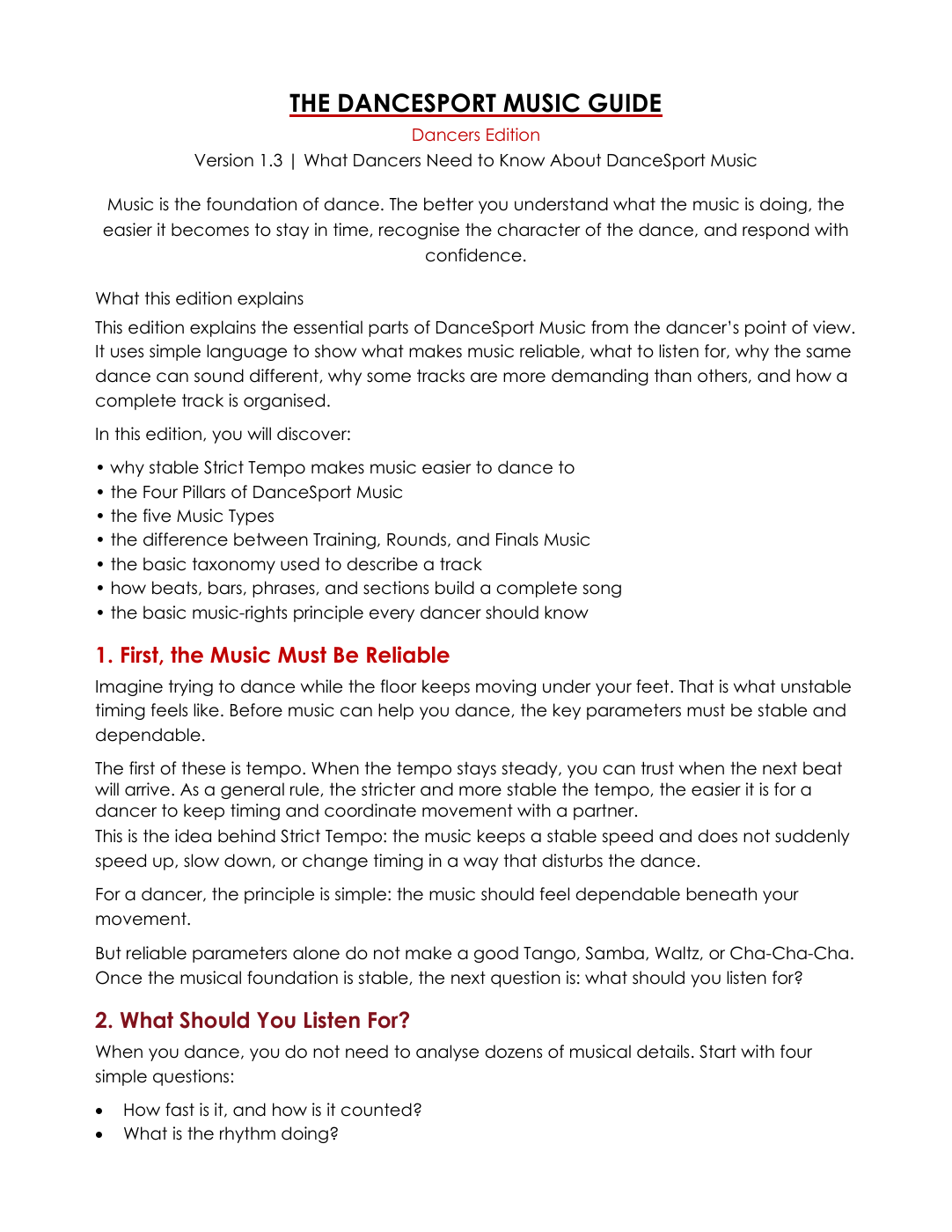
Start with a rhythm you can trust
The edition begins with Strict Tempo: a stable musical speed that gives a dancer a dependable foundation. Once that foundation is clear, the next step is to listen to the character and development of the music.
Four pillars. Four ways to listen.
The Guide organises the musical foundation into four pillars. Each one gives you a different question to bring to your next track.
01 · Parameters
How fast is the music, and how is it counted? Explore tempo, meter, phrasing and structure.
02 · Rhythm
What gives the music its rhythmic character? Listen for pulse, groove and accents.
03 · Melody
Where is the musical line going? Follow its direction and expression.
04 · Dynamics & Energy
How does the intensity change? Notice contrast, development and the kind of movement the music invites.
One dance. Different sounds.
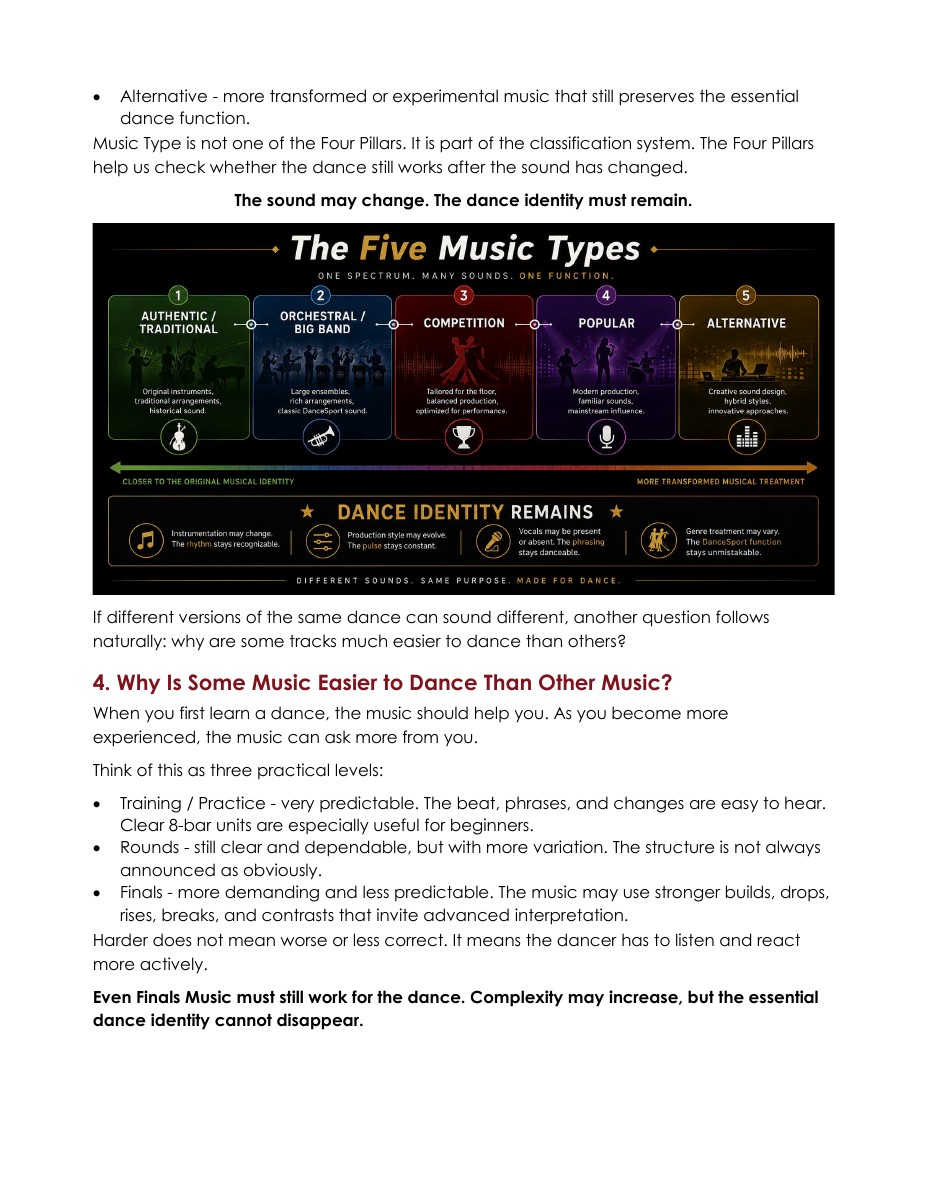
Two Cha-Cha-Cha recordings can sound very different. The edition describes five Music Types: different approaches to the sound, with the essential dance function preserved. Music Type belongs to the classification system; it is separate from the Four Pillars.
- Authentic / Traditional: rooted in the original musical identity of the dance.
- Orchestral / Big Band: a ballroom or ensemble approach.
- Competition: shaped for DanceSport clarity and function.
- Popular: familiar or contemporary music that works for the dance.
- Alternative: transformed or experimental approaches that retain the dance function.
Choose the challenge that fits the moment
The edition distinguishes three practical levels. More demanding music calls for more active listening and interpretation, while retaining the essential identity of the dance.
Training / Practice
Predictable timing and clearly audible phrases and changes. Clear 8-bar units can help beginners find their place.
Rounds
A dependable foundation with more musical variation and less obvious structural signposting.
Finals
More contrast, builds, breaks and changes in energy, inviting more advanced interpretation.
Hear the whole track
Beats form bars, bars form phrases, and phrases build larger sections. Together, those sections make the complete track. The edition uses this progression to explain how a dancer can listen beyond individual beats.
Beats → Bars → Phrases → Sections → Complete track
Many DanceSport tracks use clear 8-bar phrases. The Guide introduces this as a useful listening pattern, rather than a rule that every piece of music must follow.
Try it with your next track
Choose a track you enjoy and listen once without dancing. Ask yourself:
- Which dance does it suggest?
- Which Music Type best describes its sound?
- Who would it suit?
- How much interpretation does it ask from the dancer?
- Where would you use it: practice, competition, a show or a social dance?
These questions adapt the edition’s simple classification approach into a short listening exercise.
What this edition covers
This seven-page introduction brings together Strict Tempo, the Four Pillars, the five Music Types, Training / Rounds / Finals, basic classification and song structure. It also introduces a practical point about music rights.
The Dancers Edition is an accessible entry into the wider Guide framework. It gives dancers a starting vocabulary without requiring them to learn the full professional classification system.
Explore the music behind your movement
Sylvain van Hemert is the author of The DanceSport Music Guide, a music producer and DanceSport music specialist. Interested in the Dancers Edition or its application to teaching, DJ work or repertoire selection?