

Music Rights
Rights · Repertoire · Licensing · Distribution · Data
Connecting music rights with practical commercial and operational models.
Music Rights is a core area of Sylvain van Hemert’s work. This section brings together the questions around repertoire, ownership, licensing, distribution, royalty models and the data needed to support them.
Start with the project
What music is involved? What do you want to do with it? Which rights holders, partners and systems need to be part of the process? These are useful starting points for a conversation about a music concept and its commercial or operational model.
THE DANCESPORT MUSIC GUIDE
Music Rights Explained
From a track on a dance floor to a competition livestream: the way music is used changes the questions that need to be answered.
Drawing on Appendix 4 of The DanceSport Music Guide, this introduction connects ownership, permissions, responsibility and reporting with the everyday realities of DanceSport.
Start with four questions: who controls the music, what will happen to it, who needs to arrange permission, and what information should follow the use?
One piece of music. Two foundations.
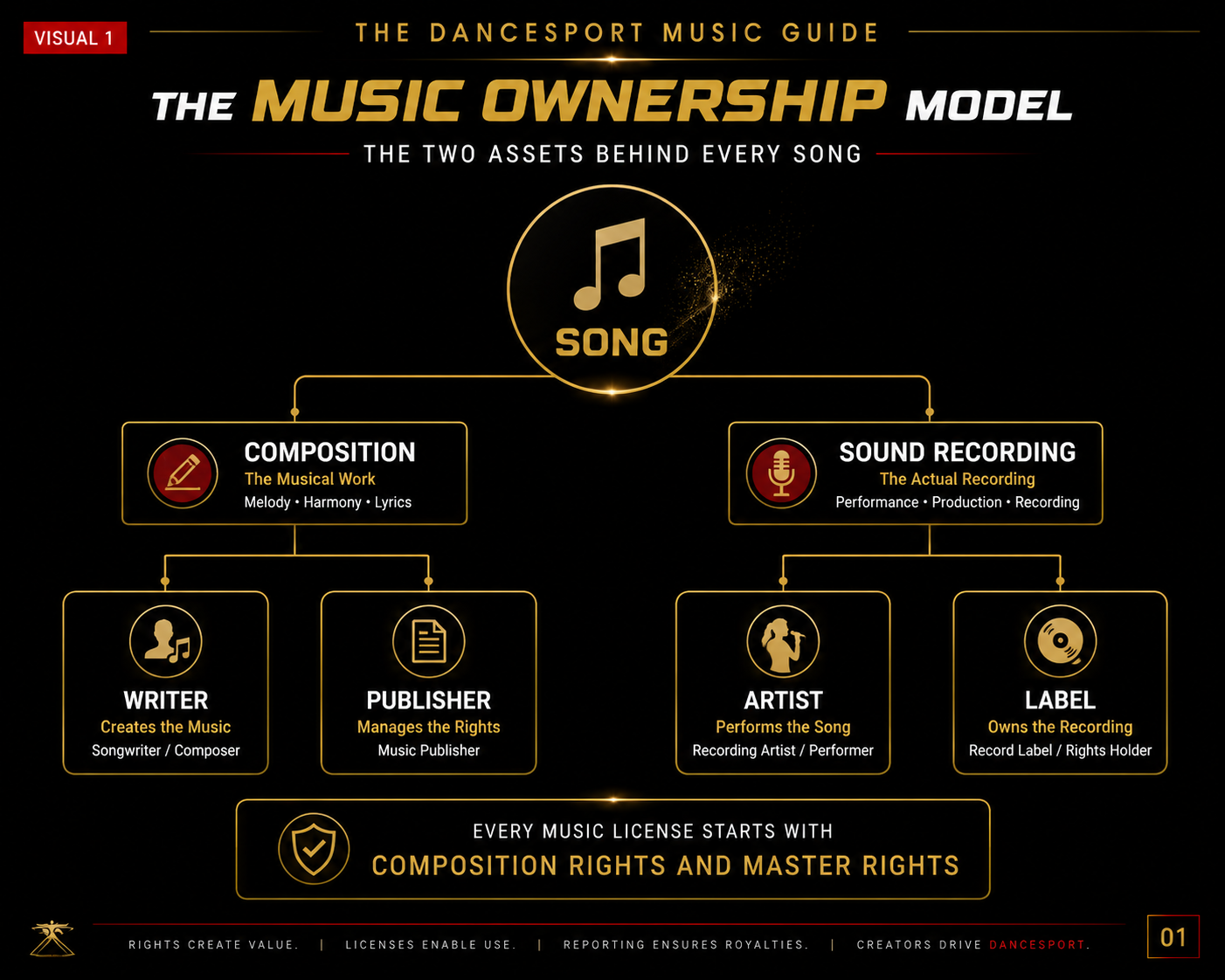
The composition
The underlying music and lyrics are associated with songwriters, composers and their publishers. Publishing rights concern this musical work and its administration.
The recording
A particular recorded performance has its own rights and rights holders. Master rights concern that specific recording. Artists, producers and labels may hold rights or contractual interests.
The composition and recording may have different owners and administrators. A useful first step is to identify both, including any shared ownership and the scope of each party’s authority.
The use shapes the permissions
Buying a track for listening does not automatically authorise public playback, copying, editing, distribution or use in video. Map the intended activity before deciding which permissions are needed.
On the dance floor
Classes, studios and competitions can involve public-performance and neighbouring-rights arrangements. Check the activity, repertoire, territory and the coverage of any existing licences.
Inside a music workflow
Copying tracks, delivering files, producing edits or remixes and releasing recordings raise reproduction, adaptation and distribution questions. Permission for playback does not automatically cover these actions.
On screen and online
Dance videos, recorded events and livestreams can require permissions concerning both the composition and recording, including synchronisation. Platform terms and licences need to be checked for the specific use.
Permissions may be arranged directly, collectively or through a combination of agreements. Some licences bundle permissions; check what they actually cover rather than assuming that one route covers every use.
Make responsibility part of the design
The person selecting a track is not necessarily the person arranging the event’s licences. Identify the studio, organiser, venue, broadcaster or platform controlling each activity, then document the relevant responsibilities and contracts.
A DJ’s sourcing, copying, editing and delivery of files needs its own consideration alongside the organiser’s or venue’s music use. A clear handover should specify who obtains permissions, who keeps the track list and who submits any required usage reports.
Connect rights with reliable data
Useful reporting starts with identifying the recording and the work behind it. Track title, version, artist, rights-holder information, dates, usage context and play counts can help connect music use with administration and royalty allocation.
ISRC identifies a specific sound recording; ISWC identifies a musical work. An ISRC is not an acoustic fingerprint. Recognition technology and identifiers serve different purposes.
Usage logs, consistent metadata and structured exchanges such as DDEX can support the workflow. Agree which data is required, who captures it and where it goes. Royalty allocation rules differ between agreements and collecting societies; logging alone does not guarantee a payment.
Independent music. Clearly defined agreements.
A catalogue with coordinated rights administration may make it easier to identify the parties to contact and discuss suitable commercial terms. Independent music still has rights, contractual conditions and reporting requirements.
For each proposed model, confirm the composition and recording rights, permitted uses, territories, duration, distribution terms, royalty arrangements and any collective-management obligations. The aim is a model that the participating organisations can operate and the rights holders can assess.
Four connected areas
Rights & Ownership
Master Rights · Publishing Rights · Repertoire Ownership
Identifying the repertoire and rights questions relevant to a concept, and the parties who need to participate.
Licensing & Commercial Models
Music Licensing · Royalty Models · Independent Music
Developing and discussing licensing, revenue and distribution approaches, including new models for the dance sector.
Distribution & Administration
Music Distribution · Rights Administration
Connecting the commercial arrangements with delivery, administration and the responsibilities of the organisations involved.
Technology & Reporting
Usage Logging & Reporting · Metadata / DDEX
Exploring the information, reporting requirements and connections between systems that a music model needs.
Expertise, delivery & development
Sylvain’s role is often that of initiator, strategic developer and connecting party between producers, rights holders, developers, dance organisations, distributors and commercial partners.
Dancelife Music I.P. B.V. focuses on intellectual property and its development. D-Sylz B.V. handles operational and commercial activities. The relevant company, partners and scope of work need to be identified for each proposed collaboration.
The topics on this page describe areas of expertise and discussion. They do not by themselves establish the availability of rights for a particular recording, territory or use, or the availability of a specific technical service.
New models for the dance sector
Music4.dance is a project in development exploring distribution, licensing, Independent Music, usage logging and reporting. Sylvain is its initiator. The project has not yet been fully commercially launched.
This work connects rights questions with the practical requirements of music use in the dance sector. Project developments should be distinguished from services that are already available.
A practical starting point
This introduction is based on Appendix 4 — Music Rights Explained, Concept Version 4.0, part of the Guide’s Version 11.1 publication set. It provides an educational framework. Local law, repertoire, agreements and platform coverage determine the position of a specific project.
For current reference information: composition and sound-recording rights, ISRC identifiers, music in audiovisual productions and Dutch music-use licensing.
Bring your question into the conversation
Describe the repertoire or concept, its intended use, the organisations involved and what you want to develop. From there, we can discuss the questions to resolve and the relevant parties to involve.
Discuss a rights or licensing project